
Introduction to Event Captaining

The Organization
As an event captain, you will be working with various organizations. An organization is an entity comprised of individuals who share a common purpose or pursue a common goal. Common organizations include businesses and corporations, non-profits, government agencies, professional associations, and cooperatives.
Organizations vary widely in terms of structure and operations. Nonetheless, there is a relatively standard vocabulary service professionals can use when referring to organizations and their employees in the event context.
Common Organizational Employees
The Client, Event Planner, Vendor, and Caterer
The client is the organization, person, or persons hosting (and often financing) the event.
The event planner plans, designs, and executes events for the client. Generally, the event planner is responsible for defining the purpose of the event, determining the scope and budget of the event, hiring and managing vendors for the event, and administering logistics for the event throughout the total event lifecycle and in accordance with the client’s requirements, recommendations, and constraints. The event planner may work for themselves, for the client, or by any number of entities. Other titles: Event coordinator, meeting planner, party planner, conference planner, event manager.
A vendor sells goods and services for the event. Common goods and services include venues, equipment rental, AV and technical support, transportation, design and decoration, photography and videography, entertainment, food and beverage, catering, and staff.
A caterer manages all food requirements for the event. Some catering organizations have an internal event planning team that may be responsible for acting as the event planner. They may also have internal staff that may staff the event.
Common Hospitality Settings
The Venue, the Back of House (BOH), and the Front of House (FOH)
Organizations gather and hold events in various hospitality settings. A venue is the general term for the hospitality setting in which a meeting, activity, or event occurs.
Venues, e.g., food service establishments or dining operations, are comprised of two areas, Back of House (BOH) and Front of House (FOH). Clients, event planners, vendors, caterers, and service professionals must have a practical knowledge of these two areas, who and what occupies these two areas, and how these two areas serve as integral parts of a whole.
A non-guest-facing area is the Back of House (BOH). BOH refers to the area primarily occupied by the culinary team, facilities, and equipment. Sometimes the culinary team itself is referred to as BOH.
The other, guest-facing area (in which service occurs) is the Front of House (FOH). FOH refers to the area primarily occupied by the service professional team, facilities, and equipment. Sometimes the service professional team itself is referred to as the FOH.
However, there is a degree of fluidity between these spaces. For instance, both the culinary team and the service professional team may share BOH during preparation and set up, execution, and breakdown. Similarly, both may share FOH during particular types of services.
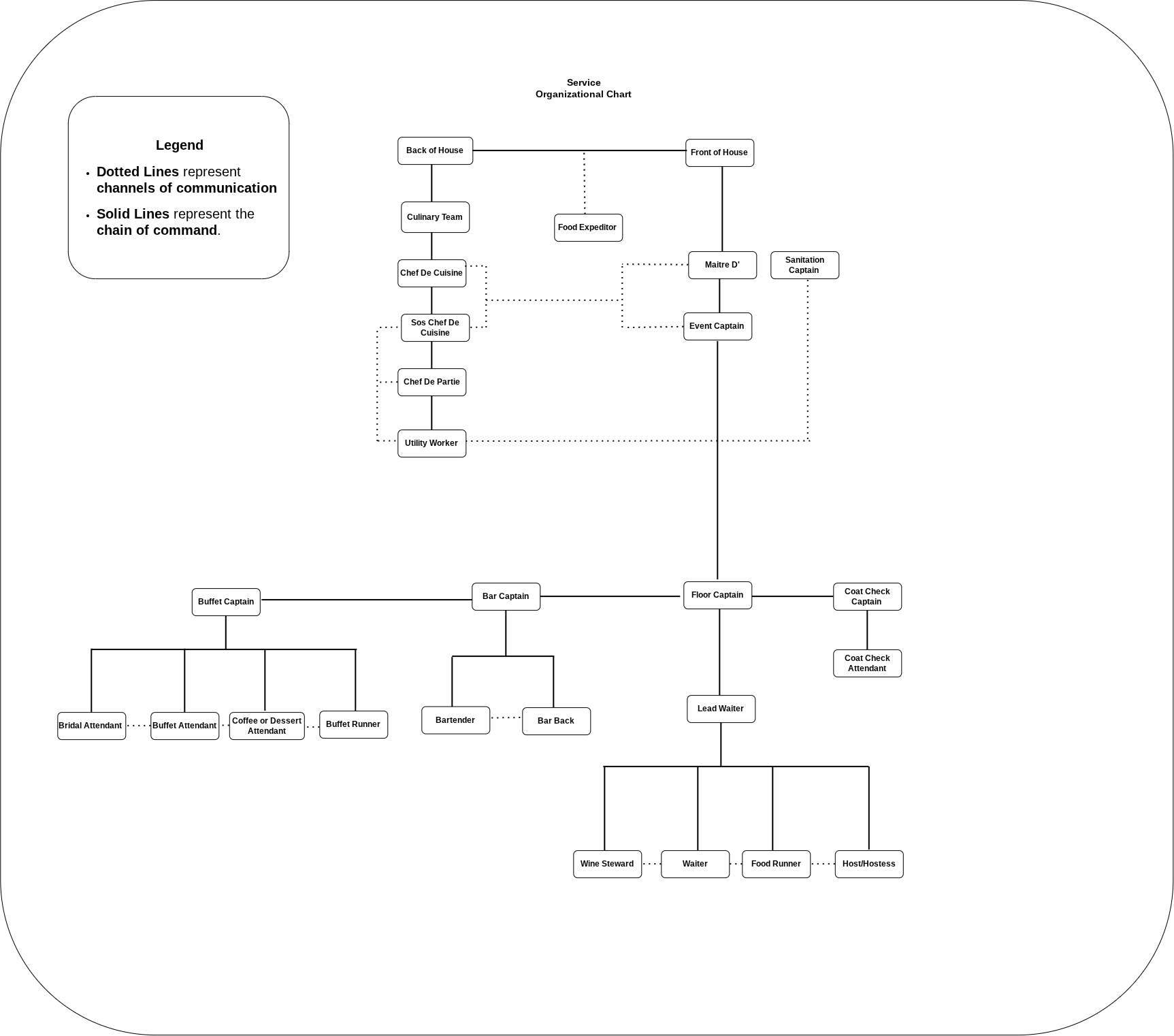
The lists below document the facilities, equipment, and roles (typical chain of command) for BOH and FOH.
BOH: Facilities, Equipment, and Roles
Common BOH facilities and equipment include:
The main kitchen
The satellite kitchen
The banquet office(s)
The ice machine(s)
The coffee machine(s)
The equipment storage area(s)
The product storage area(s)
The refuse room(s)
The loading dock(s)
The employee bathroom(s)
The employee break area(s)
The employee storage area(s)
There are a number of BOH roles and responsibilities. These roles and responsibilities may shift depending on the service type. However, there will almost always be a chef de cuisine (and their team, generally including a sous-chef and one or more chefs de partie), a food expeditor, and a utility worker.
Chef de Cuisine: This is the primary chef in an establishment, and the first-in-command of the culinary team. They lead the development of the menus and are responsible for anything served from BOH. Other titles: Executive chef, chef manager, head chef.
Sous-Chef de Cuisine: The second-in-command of the culinary team. “Sous-Chef” means “under-chef” in French. The sous-chef is responsible for executing the menu the chef de cuisine develops.
Chef de Partie: The member of the culinary team responsible for a given station. The chef de partie may be responsible for a station such as sauces, hot entrees, cold entrees and appetizers, or pastries. Each of these positions has its own title (such as the chef garde manger or pantry chef).
Food Expeditor: The member who acts as the link between the BOH and the FOH. The food expeditor manages communication between these two general areas, generally by translating orders from the service professional team to the culinary team. They are responsible for managing the proper timing and delivery of orders, ensuring correct documentation and preparation of special orders (e.g., orders with restrictions like allergies or preferences in terms of preparation or presentation). Other title: Expo.
Utility Worker: The member of the BOH team who is responsible for general cleanliness, hygiene, and sanitation. The utility worker may be responsible for dishwashing, kitchen portering, and/or sanitation management.
FOH: Facilities, Equipment, and Roles
Common FOH facilities and equipment include:
The valet area(s)
The lobby
The registration desk(s)
The host station(s)
The coat check(s)
The guest bathroom(s)
The lounge(s)
The bridal suite
The cocktail reception room(s)
The dining room(s)
The bar(s)
Like BOH, there are a number of FOH roles and responsibilities. These roles and responsibilities may shift depending on the service type. However, below are the most common roles a FOH service professional may encounter:
Maître d’: The leader and first-in-command of the service professional team. “Maître d’” means “master of the house” in French. The maître d’ is responsible for managing the service professional team, including captains. They are the main point of contact for the chef de cuisine, the sous-chef, captains, vendors, and clients.
Event Captain (Lead Captain): The second-in-command of the service professional team. The lead captain is responsible for managing service, wait staff, buffet staff, and bar staff, setup and breakdown, food and beverage deliveries, inventory, consumption, event timing and execution, and onsite account management. In the absence of a maître d’, the lead captain is first-in-command and the main point of contact for the chef de cuisine, the sous-chef, and all other captains. The lead captain may take on the roles of other captains in their absence and can work various service types, including cocktails and passed hors d’oeuvres and plated dinners.
Floor Captain (Dining Captain): The captain who is responsible for managing service on the dining room floor. This includes managing wait staff (lead and regular waiters and waitresses, wine stewards, food runners, and hosts or hostesses).
Lead Waiter or Waitress: A service professional who focuses on executing high-level service within a specific zone or section of the floor. While their primary role is direct guest service, they possess the experience to manage a small team for specialized service types and hold the authority to guide regular waiters. Although not fully trained in all captain-level administrative or structural responsibilities on a regular basis, a lead waiter is highly qualified to assist or temporarily step into a captain's role if required.
Waiter or Waitress: The member of the service professional team (and specifically the wait staff) who is responsible for providing service to guests, room setup and breakdown, greeting guests, seating guests, and offering food and beverage service.
Wine Steward: The member of the service professional team (wait staff) who is responsible for providing wine service to one or more tables.
Food Runner: The member of the service professional team who is responsible for transporting food, for food replenishment, and any ancillary components.
Host or Hostess: The member of the service professional team who is responsible for administering guest reservations and seating, greeting and seating guests, presenting menus and initial beverages, and managing waiters’ or waitresses’ side work and closeout duties.
Sanitation Captain: The captain who is responsible for managing sanitation. This includes managing sanitation, sanitation staff, setup and breakdown, equipment, coffee service preparation, and refuse removal. Sanitation often refers to a station or an area in which the collection and sanitation of unclean inventory or equipment occurs. Sanitation may be on-premises or off-premises. It is deliberately located out of the view of the guest.
Coat Check Captain: The captain who is responsible for managing the service of the coat check. This includes managing the coat check staff, setup and breakdown, inventory and equipment, guest belongings, and guest experience. Coat check staff includes coat check attendants.
Coat Check Attendant: The member of the service professional team who is responsible for greeting guests, collecting, documenting, and safeguarding guests’ personal belongings during the event, returning guests’ personal belongings after the event, and bidding farewell to departing guests.
Bar Captain: The captain who is responsible for managing service behind the bar. This includes managing bar service (including building and serving beverages), bar staff, setup and breakdown, inventory, consumption, and guest wellbeing. Bar staff includes bartenders and bar backs.
Bartender: The member of the service professional team (bar staff) who is primarily responsible for bar service (including building and serving beverages). They are also responsible for assisting the bar captain with setup and breakdown, inventory, consumption, and guest wellbeing.
Bar back: The member of the service professional team (bar staff) who is responsible for assisting the bartender with preparation for bar service (including preparing garnishes), setup and breakdown, inventory replenishment, and refuse removal.
Buffet Captain: The captain who is responsible for managing the service of a buffet. This includes managing buffet staff, setup and breakdown, equipment, and food timing, placement, and replenishment. Buffet staff includes buffet attendants, coffee or dessert attendants, and buffet runners.
Buffet Attendant: The member of the service professional team (and specifically the buffet staff) who is responsible for assisting the buffet captain with service, setup and breakdown, and food replenishment.
Coffee or Dessert Attendant: The member of the service professional team (buffet staff) who is responsible for assisting the buffet captain with service, setup and breakdown, and food and beverage replenishment of the coffee or dessert station.
Buffet Runner: The member of the service professional team (buffet staff) who is primarily responsible for transporting items between the BOH (often the kitchen) and the buffet.
Bridal Attendant: The assistant to the bride who is responsible for managing the bridal suite and attending to the needs of the bride throughout the onsite lifecycle of a wedding.