
Introduction to Floor Captaining
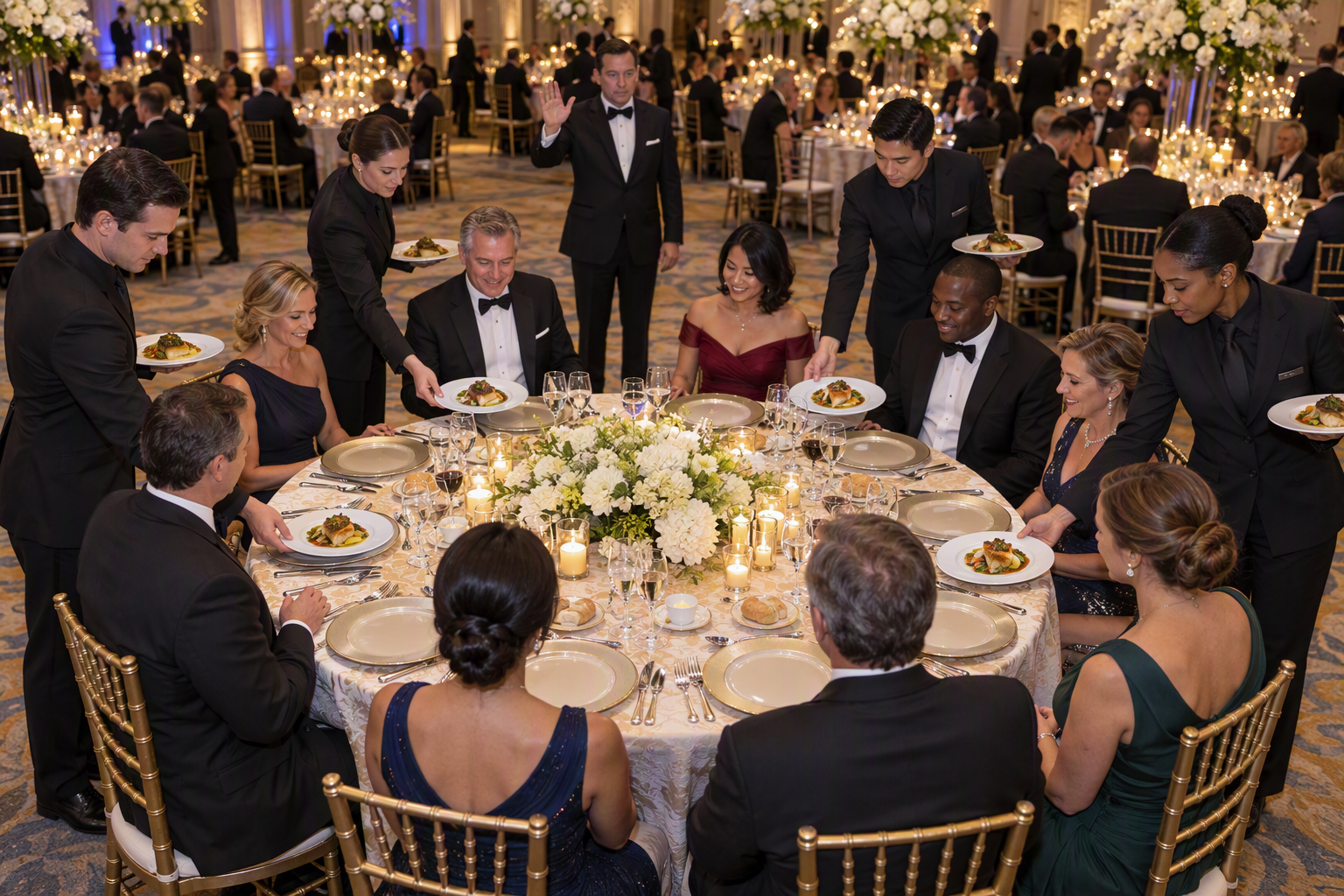
Service Types (Plated Dinner)
A floor captain should be able to set up, execute, and break down different types of plated dinner services, including synchronized service, sweep service, and clear and serve.
Synchronized Service
Synchronized service is a style in which wait staff serve guests who are seated at a table at the same time. This style of service can be used for all courses and is most effective when guests have an à la carte or choice from a menu.
Advantages
Enhanced Guest Experience: Creates a memorable and impressive dining experience.
Elevated Perception of Service: Projects an image of high-end service and attention to detail.
Precise Timing: Ensures that all guests at a table receive their dishes at the same time.
Ideal for Special Occasions: Well-suited for events where a sense of formality and elegance is desired.
Synchronized Service Steps:
Synchronized service requires coordination between the floor captain, the wait staff (including the wait staff team leader), and the expeditor. During synchonized service, each table is served by a pre-assigned team while each server in that team is responsible for two guest positions at a table.
Floor Captain Signal: To prepare to execute a synchronized service, the floor captain gives the hand signal for the wait staff to leave the floor and to line up in the kitchen to serve a course.
Wait Staff Assembly: The wait staff assemble in the kitchen in their assigned teams, by order of position. The leader is in position 1 followed by their team in the 3,5 and 7, 9, etc. Each team waits for the culinary team to plate up the orders for an entire table, for the expeditor to call the table, and direct the group to pick up the dishes that correspond to guest positions.
Floor Captain Positioning: The floor captain positions themselves in front of Position 1 at the first table, facing the kitchen.
Order Calling Guidelines
Expeditor Call: The expeditor will call the table that is first or that is next in the order.
They will call the order in the 1, 3, 5, 7, etc. positions. One staff member will be responsible for position 1 (and 2), for 3 (and 4), and so on.
The staff member will be responsible for picking up the first position (e.g., 1) with their left hand and the second position (e.g., 2) with their right hand. This is because the first position should always be served left.
Team Leader Actions: The team leader picks up positions 1 (left hand) and 2 (right hand) and waits for the rest of their group to pick up consecutive plates with the left hand and right hand until they have collected every position at the table.
Team Leader Confirmation Steps
Team Confirmation: The expeditor ensures the entire staff group has all of their plates and are ready to leave the kitchen.
The leader first confirms with their staff, “Team Ready?”
The leader then directs, “Table X Walking” (in which X refers to Table 1, 2, etc.)
The leader navigates the group to the assigned table, where the floor captain is waiting.
Floor Captain's Positioning: The floor captain positions themselves in front of Position 1 at the first table, facing the approaching service team. Using their right hand, they signal the team to proceed clockwise around the table. As they approach, the floor captain will remind them of their positions by softly counting as they pass, “Position 1, 3, 5, etc.”
Next Table Transition: Once the staff is in position, the floor captain transitions to the next table to receive and direct the next group.
Floor Captain Tips:
Group Unity: Keep groups together during service. If a guest requests something, the wait staff member should relay it to the wine steward or assure the guest they’ll return promptly.
Plate Presentation: Dishes are plated intentionally (e.g., fish at 6:00), and staff should preserve this orientation when serving.
Sweep Service
Sweep service is a style in which wait staff serve guests who are seated at a table in sections. The wait staff will serve by “sweeping the room,” starting at one end of the dining room, closest to the kitchen and completing service at the other end. Staff groups will complete serving at one table in one section and then move to the next table and next section as directed by the floor captain. Typically, the menu has been pre-selected, though alternatives (e.g., vegetarian options) may be offered.
Advantages:
Efficiency: Allows for faster service, especially in large events.
Cost-Effective: Requires fewer wait staff members to serve per table compared to synchronized service.
Scalability: Easily adaptable to different room layouts and guest counts.
Practical for Large Groups: Ideal for events where speed and efficiency are prioritized.
Less Kitchen Strain: The kitchen can plate multiple dishes at once, rather than focusing on one table at a time.
Sweep Service Steps
Floor Captain Signal: To prepare to execute a sweep service, the floor captain gives the hand signal for the wait staff to leave the floor and to line up in the kitchen to serve a course.
Wait Staff Assembly: The wait staff assemble in the kitchen in a single-file line. The team then waits for the culinary team to plate a dish(s). As soon as plates are ready, waiters pickup 2 plates at a time in their left and right hand and exit the kitchen.
Floor Captain Positioning: The floor captain stands to the left of Position 1 at the first table, facing the kitchen. With an open hand, they indicate Position 1 and the direction servers should travel.
Serving: The staff will begin serving, starting at Position 1 and moving forward (counterclockwise) to serve guests. The floor captain will remain at the table until the last staff member approaches to serve.
Next Table Transition: Then, the floor captain will transition to the next table to position and receive and direct the next servers while the previous servers return to the kitchen for additional plates. This cycle continues until all tables and sections have been served.
Post-Serve-out Check: After all of the tables are served, check in with the staff to ensure they are maintaining service and preparing for the next course.
Floor Captain Tips:
VIP Guests: Always prioritize VIP tables in the order of service when instructed by the client.
Remaining Open to the Guest: Remind servers to remain open to the guest while serving and move forward to the next.
Communicating with the Expeditor: During service, maintain communication with the expeditor to provide them table counts, and guest status as guest counts may change.
Serve and Clear Service
Serve and clear is a service style in which one group of wait staff serves a course to guests at one table while another group clears course-related tableware and flatware from the next table to prepare it for service. This is possible when all the guests are finished with the course at the same time.
Advantages
Efficient for Tight Timelines: Helps maintain momentum when there are time constraints or limited staff.
Reduces Service Downtime: By clearing and serving in succession, there’s less idle time between courses.
Reduces Steps for the Team: Lessens the workload by combining clearing and serving, so wait staff don’t lose stamina as a result of going back-and-forth between the floor and kitchen, especially in larger venues.
Steps of Serve and Clear
Clear the First Table: The first group of wait staff begins by clearing tableware, flatware, and all course-related items from the first table, preparing to receive the next course.
Serve the First Table: The next group of wait staff begins serving the new course to the first table.
Clear the Next Table: The same group of wait staff who just served the first table moves to the next table and clears it. Behind them, another group of wait staff is prepared to serve the table.
Repeat the Process: The process continues, with each group serving a table after clearing the previous one, creating a seamless flow of service where tables are consistently cleared and served in succession.