
Pre-Event Preparation and Setup
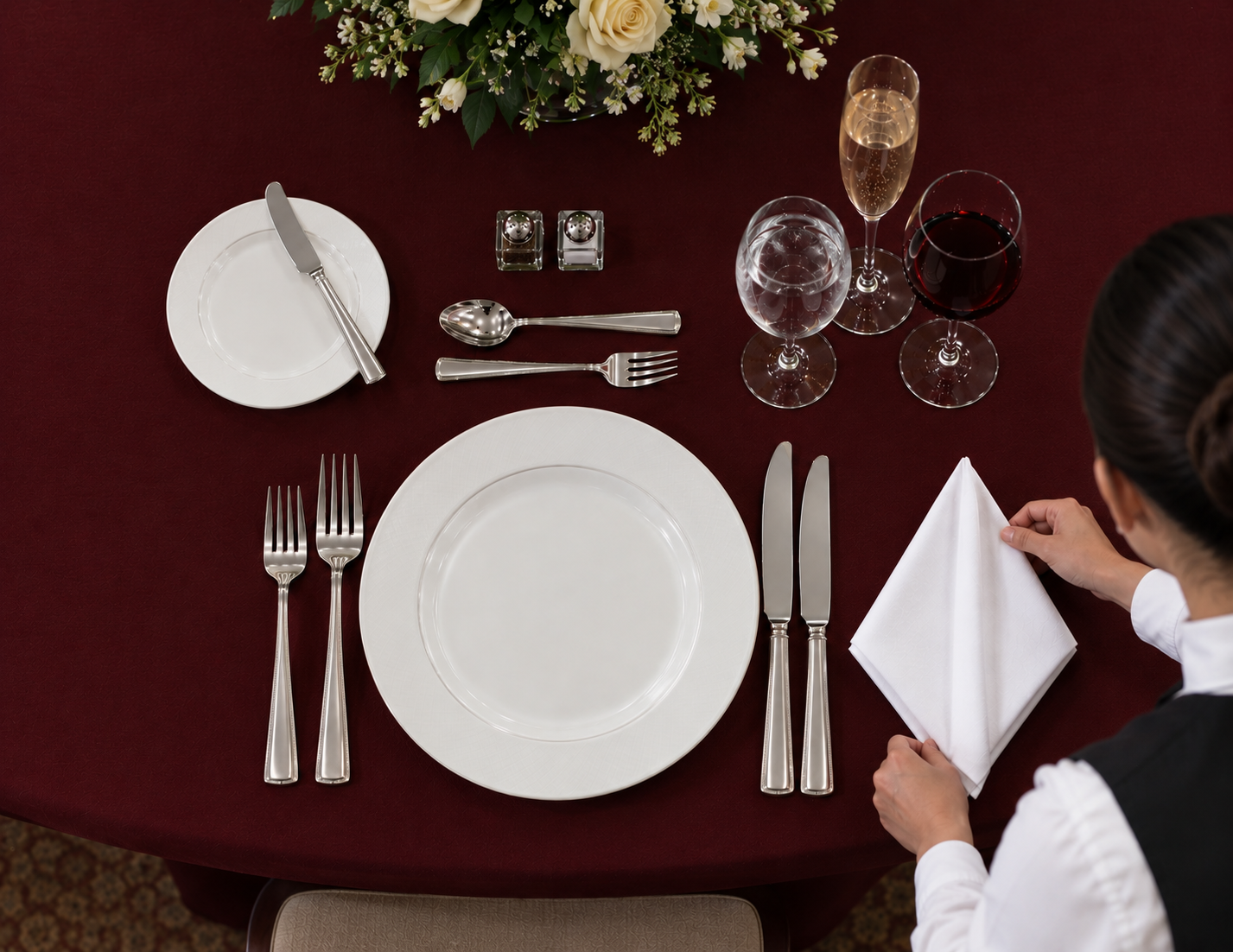
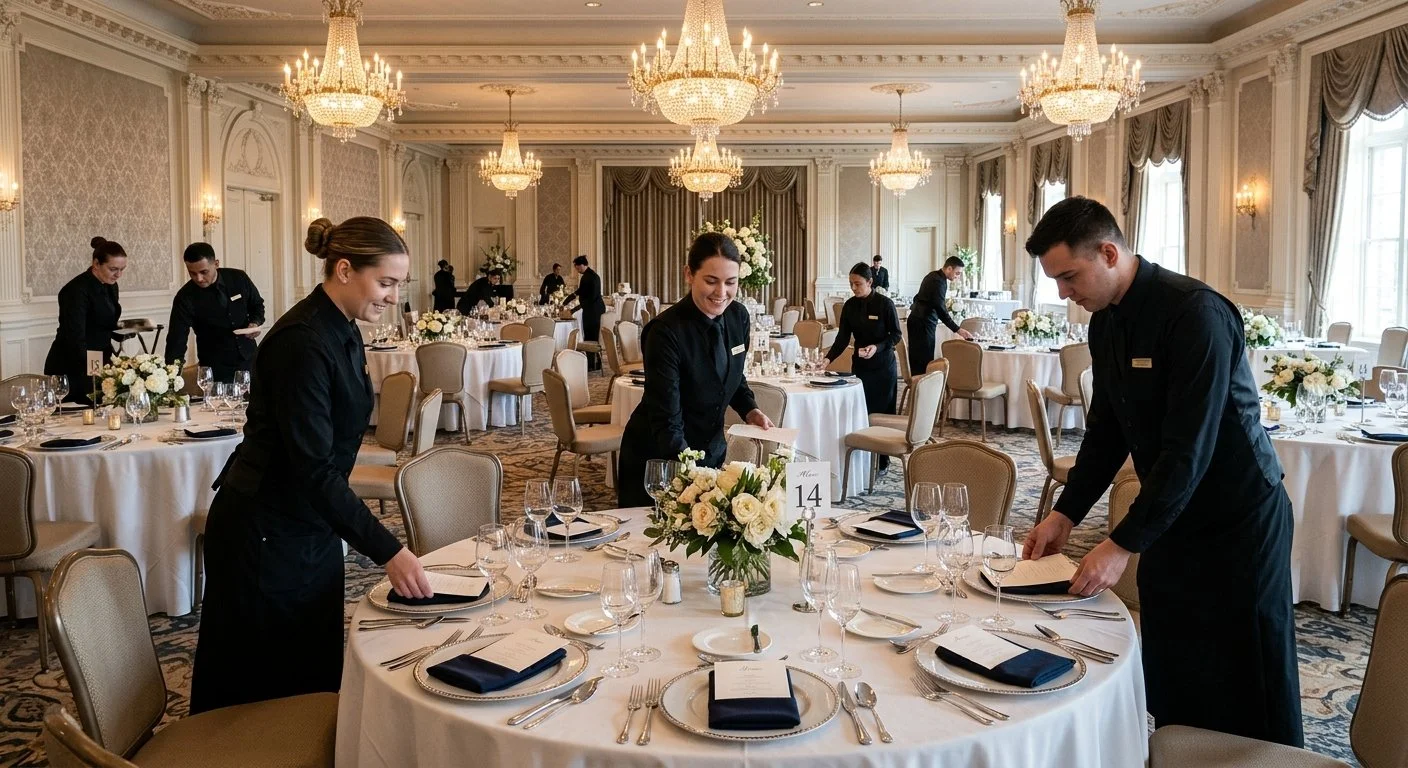
Administer Setup
The floor captain is responsible for administering setup. They must set up the room systematically, ensuring the room is ready (i.e., fully set, polished, and guest-ready) at least 30 minutes prior to guest arrival.
In this, the floor captain should adhere to the following system:
Set tables. Set up the tables farthest from where equipment first, working towards the equipment while following the floor plan for table spacing. Table spacing should ensure the service professional team and guests can comfortably navigate the space.
a. Position tables 6’ apart (edge to edge), such that there is approximately 20” between chairs for safe passage
b. Ensure legs are locked and all are running the same direction
Cover linens. Once the tables are in place, cover the tables with linens.
a. Ensure linens are kissing the floor
b. Ensure seams are all running in the same direction
Confirm setup with client. Before proceeding to set the tables, confirm with the client that the spacing and layout is satisfactory. Note that some locations have particular facilities personnel who are required to set up and position large equipment (e.g., tables).
Identify guest position 1 at the table and position a sample setting. Next, identify table positions and provide a sample setting for the service professional team to replicate.
a. Identify guest position 1 at the table, which will be the seat with its back closest to the kitchen.
b. Position a sample setting at position 1.
i. Sometimes a setting includes menus, programs, or napkin folds. If so, place those items when they become available (given these are typically the final items to be set)
ii. Sometimes facilities personnel will set up and position not only tables but also chairs. If so, reconfirm the table placement with the client, evenly space the chairs, and then proceed to the identification and setting of guest position 1
Assign setting tasks to groups of the service professional team. Divide the team into four smaller groups (if possible given the team size). Assign these groups to different tasks, remaining attentive to the salad course (with bread), the main course, and the dessert course.
a. Plate group: This should be the largest group. Direct this group to evenly divide the tables and set the foundation plates (e.g., chargers or dinner plates)
b. Flatware group: Direct this group to set silverware, working from the inside of the setting (closest to the plate) outward
c. Glassware group: Direct this group to arrange glassware, handling glassware from the stem or the base (i.e., following what is commonly referred to as the 50-50 rule)
d. Miscellaneous tabletop group: Direct this group to position miscellaneous items such as salt and pepper shakers or butter dishes. Note this group may also be responsible for assisting with the setup of menus, programs, or napkin folds
Chair up. Ensure chairs are positioned efficiently, effectively, evenly, and with minimal disruption to the tables already set. To do this, define one placement group and one support line, direct chair paths, and clarify communication between groups.
a. Placement group: This group consists of three members who are closest to the table being chaired. It includes one feeder (person who feeds the chairs from the support line) and two setters (two people who accept the chairs from the feeder and position the chairs)
b. Support line: This line consists of all remaining team members. Team members form a line from the areas in which chairs are stacked to the table that the placement group is chairing
c. Begin with the farthest table from the chair stack (generally towards the front of the space) and work towards the closest table to the chair stack (generally towards the back of the space)
d. After the first table is chaired by the placement group who is being “fed” chairs by the support line, move to the next table in the sequence. During this time, the placement group and support line should be in constant communication.
i. In this, the placement group should be communicating with the support line. The placement group (and particularly the feeder) should announce when a table has been set and the team should move to the next table. A proper announcement is one that notes the placement team is moving to the next table in a sequence: “Moving to table X”
Ensure you are following these protocols with respect to organization:
Maintain BOH organization. Organize crates, racks, and boxes by type. Maintain a “setup to breakdown” approach to maintain tidiness and ensure efficiency.
Use documentation and tools. Review floor plans and use sample table displays. Instrumentalize post-it notes and index cards to label tables during setup.
Remain adaptable. Remain flexible in the event that table counts change and/or clients request table setting modifications. If removing settings, always make sure that the team adjusts spacing but never modifies the placement of position 1.